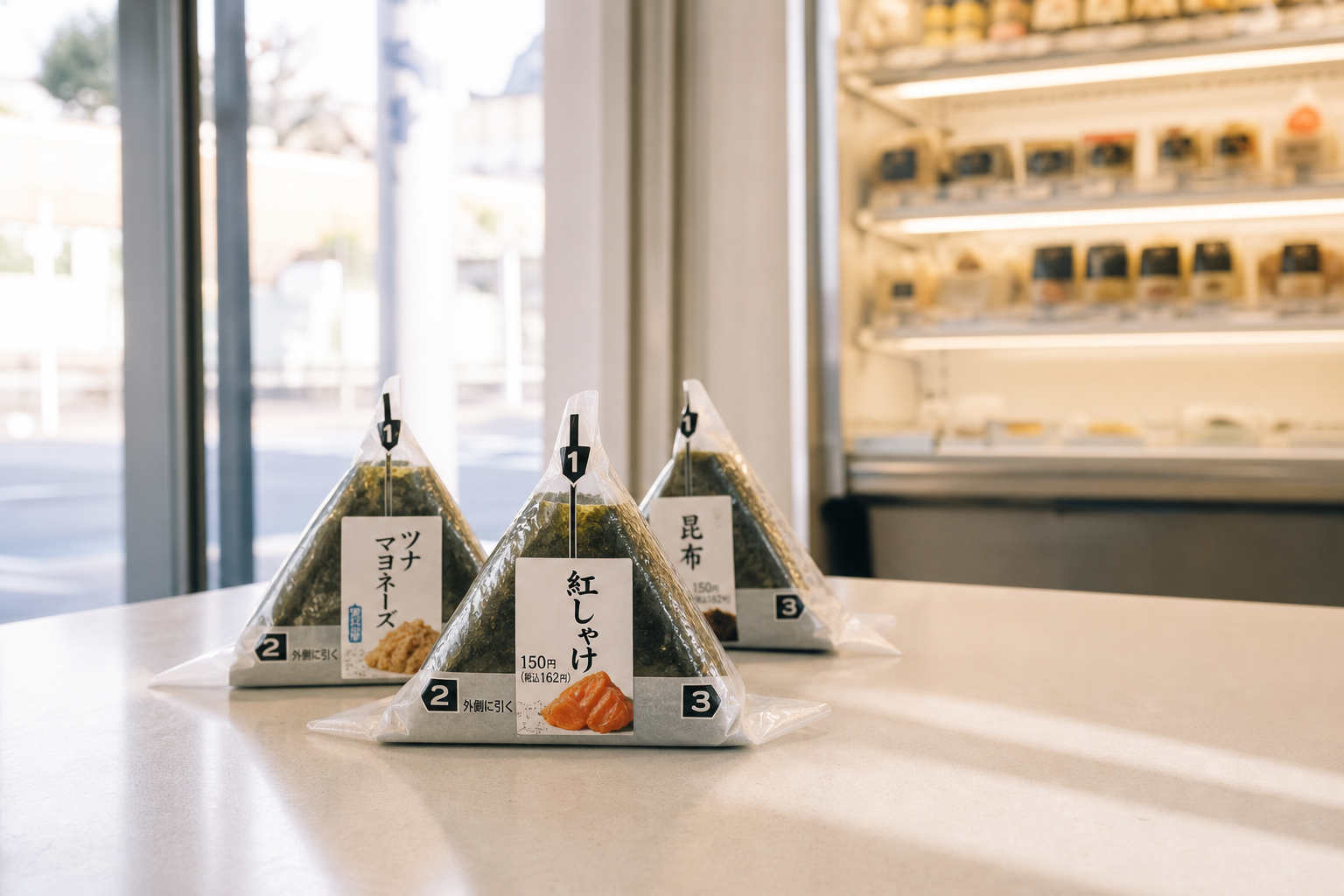
There is a particular moment in a Japanese convenience store that most visitors miss. It is not the row of egg salad sandwiches in perfect white packaging, or the coffee machine with its reassuring hiss. It is the person standing at the refrigerated shelf at 7:15 in the morning, picking up a triangle wrapped in numbered plastic tabs, then eating at the counter by the window without looking up. The whole transaction takes less than four minutes.
There is a particular moment in a Japanese convenience store that most visitors miss. It is not the row of egg salad sandwiches in perfect white packaging, or the coffee machine with its reassuring hiss. It is the person standing at the refrigerated shelf at 7:15 in the morning, picking up a triangle wrapped in numbered plastic tabs, then eating at the counter by the window without looking up. The whole transaction takes less than four minutes.
That triangle is a convenience store onigiri in Japan, often around 150 to 200 yen, with premium varieties higher. It contains seasoned rice, a filling, and a sheet of nori seaweed kept separate from the rice by a system of inner packaging so it remains crisp until the moment of opening. The design is precise, the price is low, and the product is available at all hours. Many people barely notice it anymore.
That invisibility is worth paying attention to.
—
The 150-Yen Object That Requires No Explanation
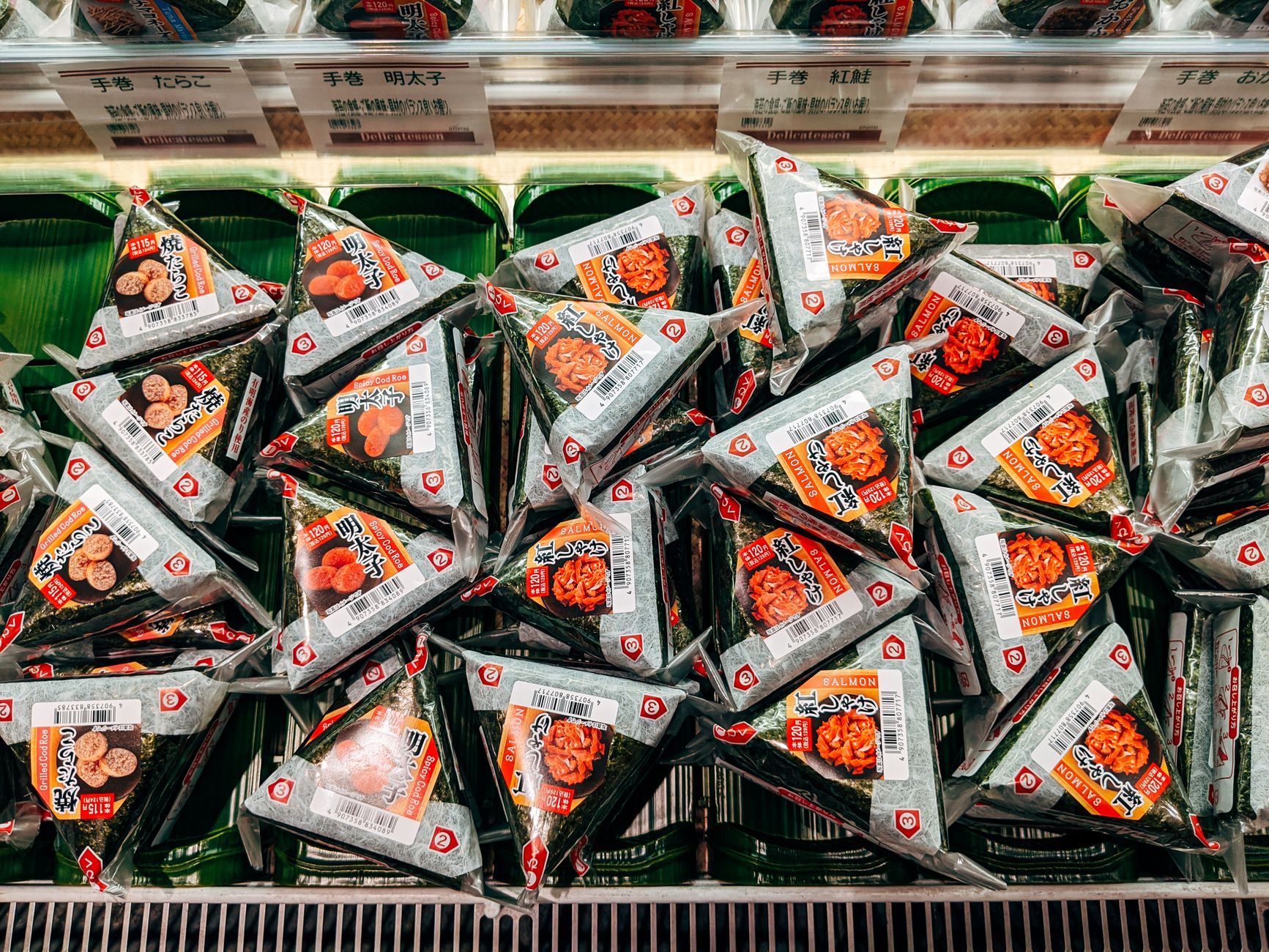
Konbini onigiri occupies a specific position in Japanese daily life. It requires no justification. A salaried worker eating one at his desk is not making a compromise. A student buying one before an exam is not settling for less. The food carries no social stigma.
In many countries, convenience food is understood as what you eat when you have run out of better options. In Japan, that hierarchy does not apply in the same way. The konbini onigiri is not a fallback. For many people, it is the first choice.
The reason has two parts: the quality is genuinely high, and the absence of stigma sustains the volume that makes high quality economically possible. These two facts reinforce each other in a loop that has been running for decades. Researchers who study Japan’s convenience store industry have noted that this feedback structure helps explain why the model is difficult to reproduce outside Japan, though the rice ball itself, as a form, is simple enough to make anywhere.
—
A Food Shaped Before Japan Had a Name for It
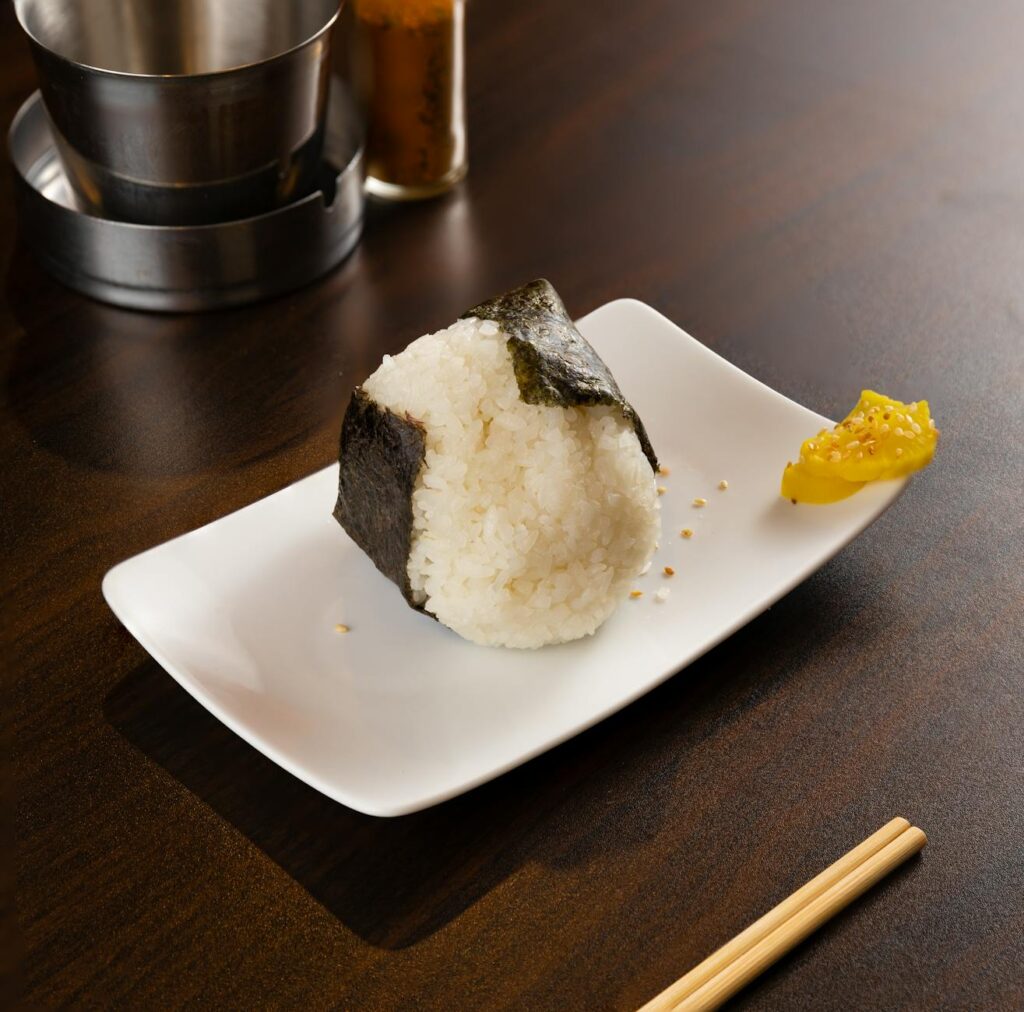
Convenience store onigiri in Japan belongs to a much older form.
What appear to be rice balls were excavated from a Yayoi-period site in Ishikawa Prefecture, dated to roughly two thousand years ago. The carbonized rice bore what researchers described as finger impressions, suggesting the rice had been shaped by hand. Whether these were provisions, offerings, or something else is a matter of interpretation among scholars.
The written record is clearer from the eighth century onward. A text compiled around 721, the Hitachi no Kuni Fudoki, describes people carrying pressed rice called nigiri ii as they went about their daily work. The name comes from the verb nigiru, meaning to grip or press. The act is encoded in what you call it.
The word omusubi, used interchangeably with onigiri in parts of Japan, derives from musubu, meaning to bind or connect. Some accounts link this to early Japanese cosmology, though the etymology is debated. The word’s association with connection was chosen deliberately in 2000, when an organization designated January 17 as Omusubi Day in memory of the 1995 Hanshin earthquake, when volunteers distributed rice balls by hand to thousands of displaced people.
Samurai are recorded in historical sources as carrying onigiri as provisions during the Kamakura period. The fillings of that era were practical: umeboshi, with its acidity, extended the rice’s safe carrying time without refrigeration. The sour, intensely salty pickled plum was not merely traditional. It was functional. The food was engineered for portability long before that word applied to food.
The triangular shape now associated with konbini onigiri has its own layered history. Some accounts link it to mountain veneration in Shinto, though this interpretation is not universally accepted. Others point to structural practicality: the triangle is more stable than a round ball and easier to stack. Both readings may be accurate, and both have persisted without contradiction.
—
1978 and the Packaging That Changed Everything
The konbini onigiri as a recognizable modern product has a specific origin point.
In 1978, Seven-Eleven Japan introduced the special film packaging that made modern konbini onigiri recognizable. The system was not just a rice ball in plastic. It was a layered wrapper that kept the nori separate from the rice until the moment of opening. Pull tab one, pull tab two, slide the nori into place. The nori arrives crisp. The rice arrives cold but ready to eat, or warm after a brief microwave. The system is operable without language, without instruction, by any pair of hands.
That packaging solved a real problem. Nori becomes soft quickly when it contacts rice, losing the textural contrast that makes the food satisfying. Solving this required a specific geometry of plastic film, a sequence of folds, and enough structural integrity to survive a refrigerated distribution chain. The result is what researcher Gavin Whitelaw, writing on onigiri and Japan’s convenience store industry at Harvard, has described as a product whose convenience is inseparable from its cultural resonance with the Japanese consumer.
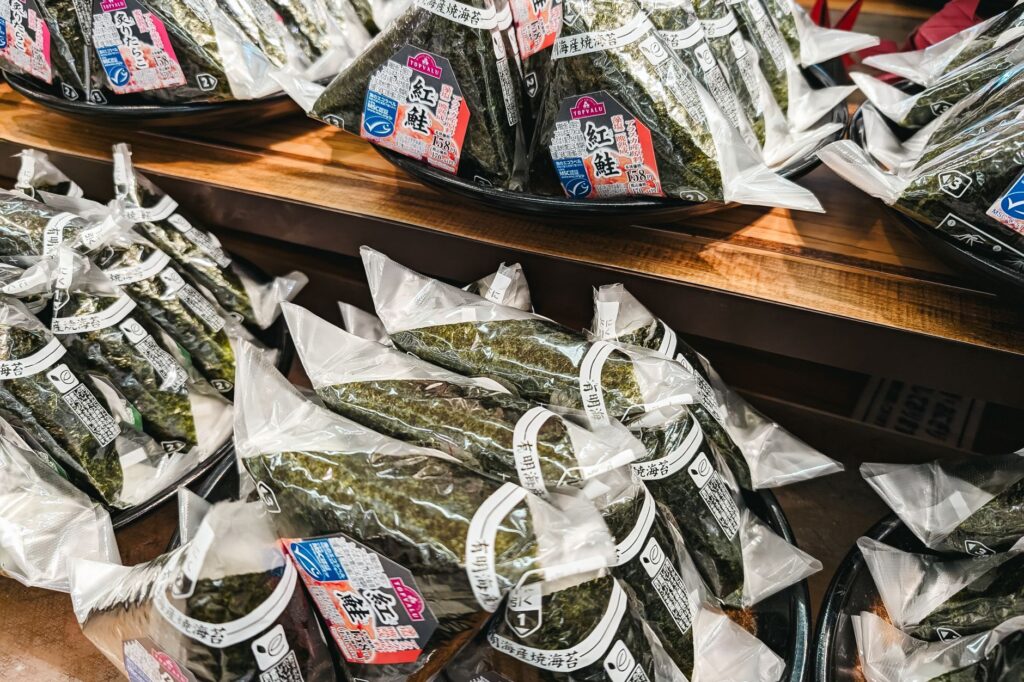
In 1983, tuna mayonnaise onigiri was introduced and quickly became one of the most widely sold varieties at convenience stores. The combination of canned tuna and Kewpie mayonnaise is simple. The result is mild, protein-rich, and satisfying at any hour. It remains one of the most reliably available fillings at every major chain.
Today, the major konbini chains compete continuously on onigiri variety and quality. Limited seasonal offerings appear throughout the year. The product has a seriousness of attention that casual observers rarely expect from food at this price point.
—
No Stigma and the Eat-In Corner
Many konbini now include a small eat-in area (eat-in, or イートイン in Japanese): a counter, a few stools, a microwave. These spaces are not designed for gatherings. They are designed for one person.
In Japan, eating alone in public has a name: hitorimeshi (一人飯), meaning “one-person meal.” The related concept of ohitorisama (“the esteemed solo individual”) appears in restaurant design, booking systems, and consumer culture across the country. Ichiran Ramen, among others, built private booths specifically so solo diners can focus entirely on their bowl without social pressure.
Eating a convenience store onigiri in Japan alone at a konbini counter is a version of this. The format is complete on its own terms. You chose what you wanted. You opened it in the correct sequence. You ate. No performance was required.
This quality of self-contained adequacy is part of what the food carries. It asks nothing of the person eating it. It meets you where you are, at whatever hour, and does not require explanation. The practice of eating alone in Japan carries more cultural depth than the act itself suggests.
—
What the Wrapper Teaches You
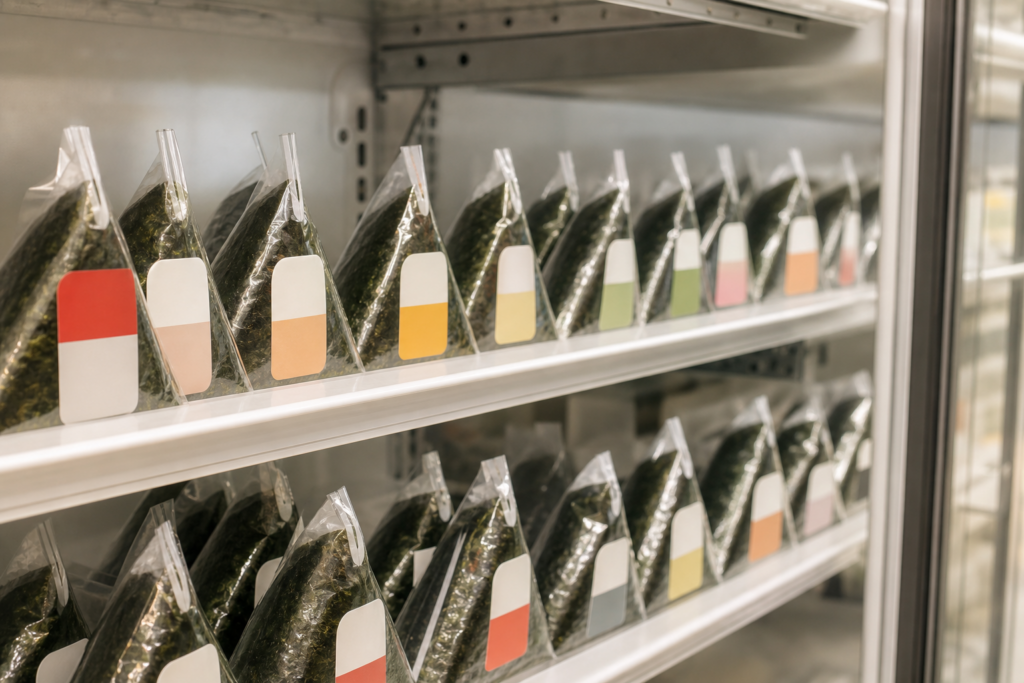
The three-tab wrapper on a convenience store onigiri in Japan is a small object lesson.
Most people figure it out on the first try. The numbered tabs are printed directly on the plastic. The design assumes you have never done this before and will not need to be told twice. It works in a hurry, in the dark, on a commuter platform.
The design team that developed this wrapper was solving a specific problem: how to deliver a two-texture food to a customer who might be walking, commuting, or sitting at a counter at 6 in the morning. The constraint shaped the solution. The solution is now widely associated with the konbini onigiri image, imitated in South Korea’s samgak-gimbap and referenced in food writing far outside Japan.
What the wrapper reveals is not a general truth about Japanese culture. It reveals something specific: that someone spent considerable time on a 150-yen object, on the assumption that a 150-yen object was worth spending time on. The same quiet assumption appears in a traditional kissa where the coffee is made with care for a customer who may sit for an hour without being rushed.
The triangular rice ball at 7:15 in the morning, under the fluorescent light of a convenience store, holds that assumption. You open it, eat it, fold the wrapper, and leave. It required nothing from you except attention. That is, in its way, enough.
—
FAQ
What is convenience store onigiri in Japan? Convenience store onigiri in Japan is a factory-made rice ball sold at konbini such as Seven-Eleven, Lawson, and FamilyMart. It typically contains a filling such as salted salmon, tuna mayo, or pickled plum, wrapped in nori sealed in a three-part packaging designed to keep the nori crisp until opened. Prices are often around 150 to 200 yen, with premium varieties higher, depending on filling and store.
What are the most common onigiri fillings? The most widely sold fillings include tuna mayonnaise, salted salmon (shake), pickled plum (umeboshi), and seasoned kelp (kombu). Seasonal and limited-edition varieties appear throughout the year at all major chains.
Is konbini onigiri fresh? Japanese convenience stores typically restock multiple times daily, and each item carries a specific expiration time rather than just a date. The standard expectation in Japan is that konbini food is fresh, and the distribution system is designed around this assumption.
Why is Japanese convenience store food so good? The quality reflects a supply chain engineered for it: dedicated factories, multiple daily deliveries, and a consumer culture with no stigma attached to convenience food. These conditions sustain the investment that makes the quality possible.